


Arnica
Arnica has so many therapeutic virtues that it deserves our utmost respect
The benefits of arnica are many and have been known for a long time. And we, at Laboratoires Boiron, do our utmost to preserve them and put them to work for your health. From growing and harvesting the plants to transforming them into health solutions.
Therapeutic effects known since Antiquity
The history of Arnica is closely linked to that of medicine. Its use in pharmacopoeia dates back to ancient Greece. From the 1st century AD, to be precise. The plant named “alcimos” by the physician and botanist Dioscorides is thought to be mountain arnica. “Alcimos” meaning “salutary”. Since that time, arnica’s many therapeutic virtues have made it one of the most widely used medicinal plants. It is rich in anti-inflammatory and analgesic active ingredients. But this is not its only quality. On the contrary, arnica has many other properties. (1) (2)

Arnica: a plant with many benefits
Arnica’s effects are numerous, as it is a plant rich in over 150 active therapeutic substances. That’s why the question “When should I use arnica?” can be answered in so many ways. Arnica has 3 major properties: it is anti-inflammatory, analgesic and soothing. It is a natural analgesic that relieves muscular tension. It can be highly effective in reducing hematomas. And it soothes joint pain and arthritis. But arnica has many other virtues. It is also healing, antioxidant, vasoprotective and venotonic… (3)(4)
The secrets of Arnica
Over 150 substances identified
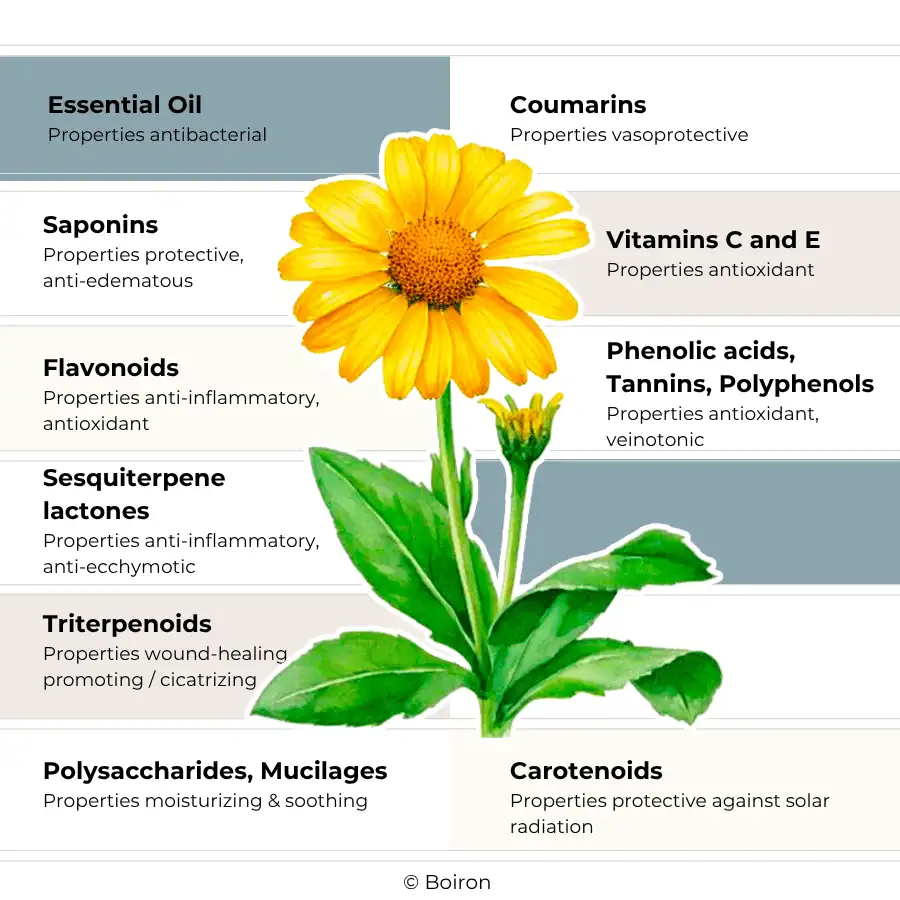
Flavonoids, lactones, phenolic acids, triterpenoids… these are the scientific names of the substances in arnica that take care of your health. Discover them all in this diagram. (5) (6)
The WHO view
The World Health Organization (WHO) recognizes the “traditional” use of Arnica “as a local treatment for pain and inflammation caused by minor contusions and accidents (bruises, hematomas)” as well as in “the local treatment of inflammation, insect bites and superficial phlebitis (the presence of a blood clot in a vein under the skin, such as a varicose vein)”. (8)
Where does Arnica montana grow?
Arnica montana – or mountain arnica – is a perennial plant that grows above 800 meters in mid-mountain pastures. When fully grown, it can reach 60 cm in height. Its flowers are 5 to 6 cm wide and can be recognized by their yellow-orange color. Arnica montana is mainly found in Europe. In France, it is at home almost everywhere at altitude: in the Pyrenees, Massif Central, Aveyron, Ardennes, Vosges and in the foothills of the Alps. (7)
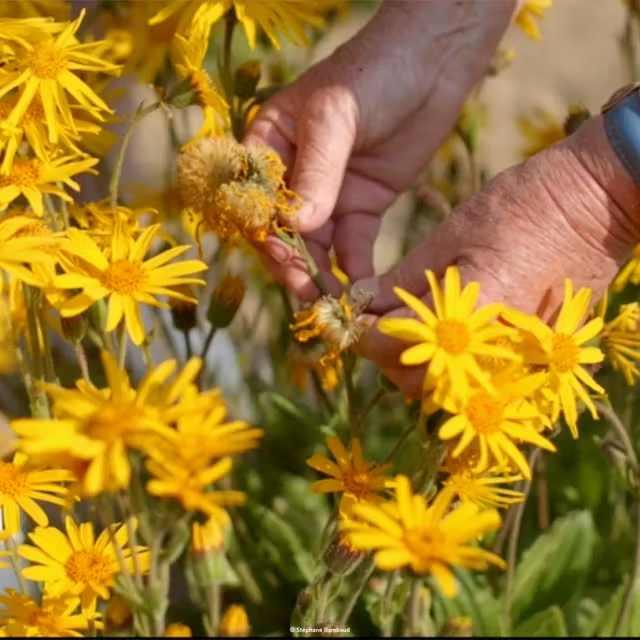
As the sustainability of raw materials is one of Laboratoires Boiron’s major challenges, we are involved in collective actions to preserve plants in their natural environment, in the parks of the Vosges and the Pyrenees.
Here are a few examples:
– harvesting is exclusively manual and involves plants in full bloom,
– authorization to harvest wild plants must be systematically requested from local authorities.
Responsible cultivation
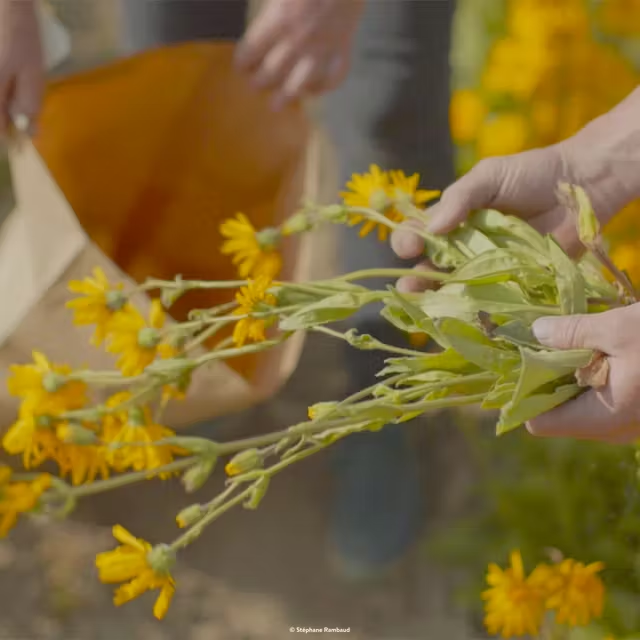
And to protect arnica even further, we now prefer to grow it organically. In 2023, 95% of the plants we used were of organic origin.
Everything in the cultivation and harvesting of arnica is done to take the utmost care of the plant and biodiversity. To this end, specific specifications have been drawn up, specifying, for example, that harvesting must be carried out responsibly and only during the flowering period, in June and July. What’s more, we surround ourselves with professional partners who share the same ethos of environmental protection, sustainable development and traceability. This is the case, for example, with the Leduc family, growers from mother to son, with whom we have collaborated in complete confidence and transparency for almost 30 years.
What is Boiron Arnica?
It’s all in the fresh plant
For Laboratoires Boiron, respecting arnica means respecting the benefits of its active ingredients. That’s why we’ve chosen to use only fresh plants, picked whole and in full bloom. As soon as they are harvested, the plants are transported to our laboratories within 48 hours. On receipt, rigorous controls ensure quality, moisture content and absence of radioactivity. Plants also undergo phytochemical analysis. If the results are positive, the processing phase can begin. Then, at the end of the manufacturing process, each batch of extract obtained is controlled according to French Pharmacopoeia specifications to guarantee its quality and efficacy.
“Arnica is my daily ally. To support my efforts in top-level sports. Or to help relieve my little worries and those of my children in our everyday lives.”
Mélina Robert Michon – French discus thrower

Written in collaboration with:
Dr. Khalil Taoubi
Ph.D. in pharmacognosy. Expert in botany, toxicology, and pharmacopoeia.
(1) Wichtl M, Anton R. Plantes thérapeutiques. Ed. Tec & Doc – EM inter, 1999, 47-51. Eymard L.
(2) Arnica montana, de nos grands-mères à nos comptoirs, Thèse pharmacie, Marseille, 2017.
(3) Pinkas M., Pinchon T.M. Arnica montana L. (Asteraceae) ; in Cornillot : Acupunture & Médecine traditionnelle chinoise, Phytothérapie & Aromathérapie, Homéopathie. Ed. Fison-Roche, 1996, 77-83.
(4) For antioxidant properties: Paumier A, Verre J, Tribolo S, et al. Anti-oxidant Effect of High Dilutions of Arnica montana, Arsenicum Album, and Lachesis Mutus in Microglial Cells in Vitro. Dose Response. 2022 Jun 29 ;20(2):15593258221103698.
(5) For lactones: Drogosz J, Janecka A. Helenalin – A Sesquiterpene Lactone with Multidirectional Activity. Curr Drug Targets. 2019;20(4):444-452. .
(6) For flavonoids and phenolic acids: Ganzera M et al. Quantitative analysis of flavonoids and phenolic acids in Arnica montana L. by micellar electrokinetic capillary chromatography. Anal Chim Acta 2008; 614: 196-200.
(7) Tutin T.G., Heywood V.H., Burges N.A. et al (1976) – Flora Europea – Cambridge University Press (G.B.)
(8) Monographie OMS ARNICA – 2007 : https://apps.who.int/iris/bitstream/handle/10665/42052/9789241547024_eng.pdf?sequence=3&isAllowed=y page 89


